
Read in: English · Français · Español · العربية · 中文
Every time you “move a term to the other side” of an equation, you are using a method described more than 1,100 years ago in Baghdad. Even the word algebra comes from that book.
The story
In the early 9th century, Caliph al-Ma’mun (who ruled from 813 to 833) supported a famous academy in Baghdad, the House of Wisdom. One of its scholars was Muhammad ibn Musa al-Khwarizmi.
He wrote The Compendious Book on Calculation by Completion and Balancing (in Arabic, al-Kitab al-mukhtasar fi hisab al-jabr wa’l-muqabala). Al-jabr means “restoration” or “completion”: getting rid of a subtracted quantity by adding it to both sides. Al-muqabala means “balancing”: cancelling equal amounts on both sides.
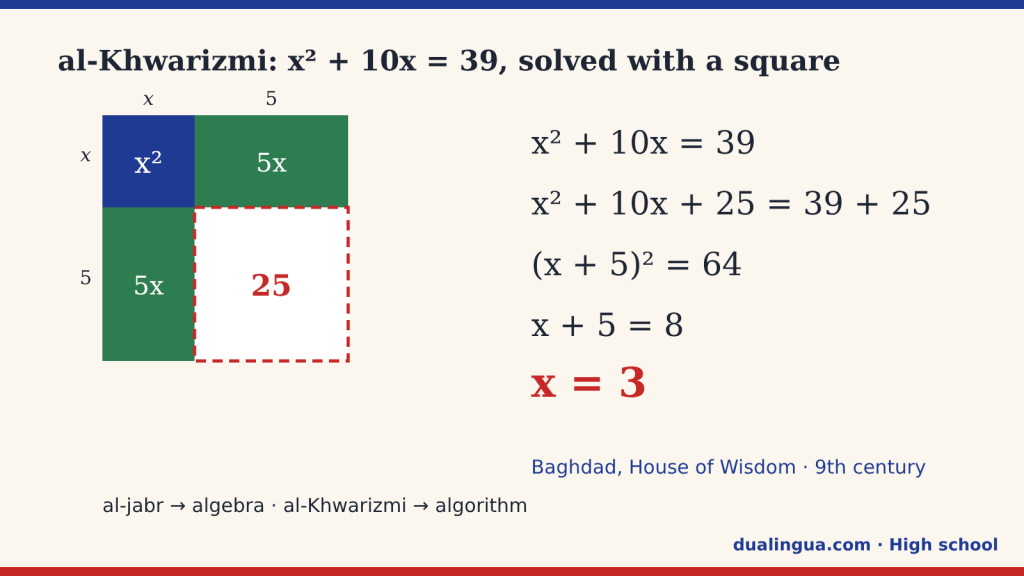
There were no symbols like x or = at the time. Al-Khwarizmi wrote everything in words, for example: “a square and ten roots are equal to thirty-nine”. Today we write x² + 10x = 39. He solved it with a drawing: a square of side x, plus two rectangles of 5 by x. The missing corner is a 5 by 5 square, so adding 25 “completes the square”: (x + 5)² = 64, so x + 5 = 8 and x = 3.
His books were translated into Latin in the 12th century. The word algebra comes from al-jabr, and algorithm comes from the Latin form of his own name, used for his book on calculating with Hindu numerals.
Timeline
| When | What happened |
|---|---|
| 813–833 | Reign of al-Ma’mun, patron of the House of Wisdom |
| 9th century | Al-Khwarizmi writes his book on al-jabr and al-muqabala |
| 12th century | Robert of Chester and Gerard of Cremona translate the algebra into Latin |
What this means for your maths
Al-jabr and al-muqabala are still the two moves you use for every equation. In 2x − 3 = 11, “restore” by adding 3 to both sides: 2x = 14. Then divide: x = 7. For quadratics, completing the square is behind the quadratic formula itself.
3 tips
- Whatever you do to one side, do to the other: an equation is a balance.
- Get rid of subtractions first (al-jabr), then collect like terms (al-muqabala).
- To complete the square for x² + bx, add (b ÷ 2)². Then always check your answer by substituting it back.
Try it
- Solve 2x − 3 = 11.
- What number completes the square for x² + 6x?
- Solve x² + 6x = 16 by completing the square (positive answer).
Show the answers
1. x = 7
2. 9, because (6 ÷ 2)² = 9
3. x² + 6x + 9 = 25, so x + 3 = 5 and x = 2
Practise for free: Quadratic equations (grades 10–12)
Want a patient teacher? Dualingua offers live online maths lessons from grade 1 to exam preparation, in English or French. Book a free assessment.
More free maths: all free maths lessons · the Dualingua maths blog