
Read in: English · Français · Español · العربية · 中文
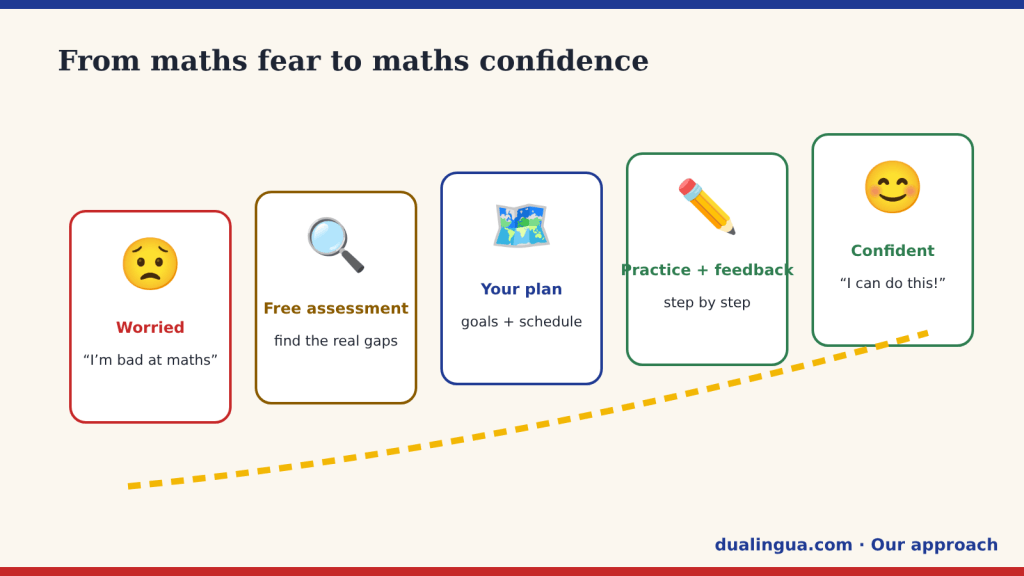
Many learners arrive saying “I’m just bad at maths”. Usually, the real problem is smaller and fixable: a missing foundation, a rushed explanation, or anxiety that blocks what they already know. Our approach tackles these one by one.
1. Find the real gaps
Everything starts with a free assessment with a teacher. A difficulty with equations in grade 9 often comes from fractions in grade 5. Finding the starting point saves months of frustration.
2. Build a personal plan
We match each learner with a teacher and a plan built around their goals, level and schedule: catching up, preparing for a test, or aiming higher. For school-aged learners, the plan follows the Canadian curriculum.
3. Explain step by step, patiently
Our excellent teachers explain ideas clearly and in more than one way, and they make it safe to make mistakes. A calm learner has more “mental space” for maths: research on maths anxiety shows that worry uses up the working memory needed to calculate.
4. Practise in the way that works
Learners practise by trying problems themselves, not just watching. Research shows that self-testing and spaced practice are among the most effective ways to learn, and that mixing problem types improves maths test results. Between lessons, our free online lessons give extra self-checking practice.
5. Follow progress
Learners keep the same teacher, who follows their progress closely, and families receive regular progress reports. Seeing progress is one of the best cures for maths anxiety.
Our five steps at a glance
| Step | Why it matters |
|---|---|
| Free assessment | Finds the real starting point |
| Personal plan | Fits the learner’s goals and schedule |
| Patient, step-by-step teaching | Lowers anxiety and builds understanding |
| Active practice | Self-testing and spacing make learning last |
| Progress reports | Shows results and builds confidence |
What you can do today
- Try one free lesson and note which exercises felt hard.
- Write down the topics that worry you most.
- Book a free assessment and bring your notes.
Next step: Book a free assessment with a Dualingua teacher
Want a patient teacher? Dualingua offers live online maths lessons from grade 1 to exam preparation, in English or French. Book a free assessment.
More free maths: all free maths lessons · the Dualingua maths blog
Sources
- Mathematics tutoring – Dualingua
- About Dualingua: our teachers and method
- Free maths lessons – Dualingua
- Writing about worries eases anxiety and improves test performance – University of Chicago News
- Which study strategies make the grade? – Association for Psychological Science
- Rohrer et al. (2014), Interleaved practice improves mathematics learning – Psychonomic Bulletin & Review