
Read in: English · Français · Español · العربية · 中文
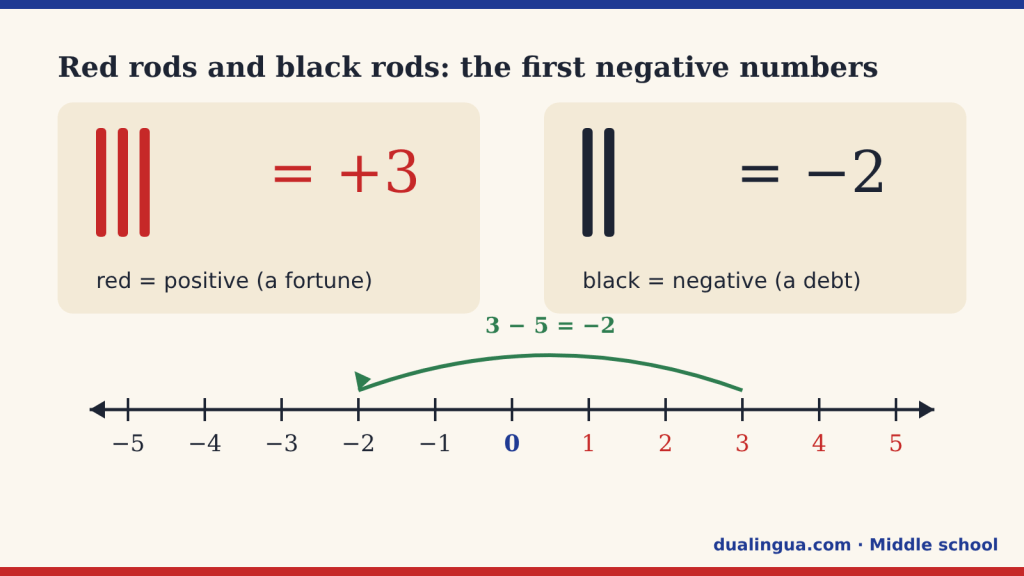
Today −10 °C on a winter morning in Canada seems perfectly normal. But for a very long time, many brilliant mathematicians thought that a number smaller than nothing was impossible. Here is how negative numbers won the argument.
The story
In ancient China, people calculated with small bamboo or bone sticks called counting rods. Red rods stood for positive numbers and black rods for negative ones. The famous book The Nine Chapters on the Mathematical Art, put together over several centuries and completed around the 1st century CE, gives rules for adding and subtracting positive and negative numbers to solve systems of equations.
In Greece, around the 3rd century CE, Diophantus met an equation like 4 = 4x + 20. The answer, x = −4, seemed so strange to him that he called it “absurd”.
In India, in 628, Brahmagupta treated negative numbers as debts and positive numbers as fortunes. He wrote rules such as “a debt subtracted from zero is a fortune” and “the product of two debts is a fortune”. That second rule is exactly our modern (−) × (−) = (+).
In Europe, negative numbers stayed controversial for a long time. As late as 1758, the English mathematician Francis Maseres argued that they should not be used at all. Little by little, though, bankers, scientists and teachers showed how useful they were, and today you meet them on every thermometer and bank statement.
Timeline
| When | What happened |
|---|---|
| around the 1st century CE | The Nine Chapters gives rules for positive and negative numbers |
| 3rd century CE | Diophantus calls a negative answer “absurd” |
| 628 | Brahmagupta’s rules for fortunes, debts and zero |
| 1758 | Francis Maseres still argues against negative numbers |
What this means for your maths
Brahmagupta’s idea still works perfectly: think of positive numbers as money you have and negative numbers as money you owe. If you have $3 and spend $5, you owe $2: 3 − 5 = −2. Our free lesson on integers practises exactly this.
3 tips
- Think in money: a fortune (+) or a debt (−).
- Use a number line: adding moves right, subtracting moves left.
- Same signs multiply to positive, different signs to negative: (−6) × (−2) = 12, (−6) × 2 = −12.
Try it
- −4 + 9 = ?
- 3 − 8 = ?
- (−6) × (−2) = ?
Show the answers
1. 5
2. −5
3. 12
Practise for free: Integers and negative numbers (grades 6–7)
Want a patient teacher? Dualingua offers live online maths lessons from grade 1 to exam preparation, in English or French. Book a free assessment.
More free maths: all free maths lessons · the Dualingua maths blog