
Read in: English · Français · Español · العربية · 中文
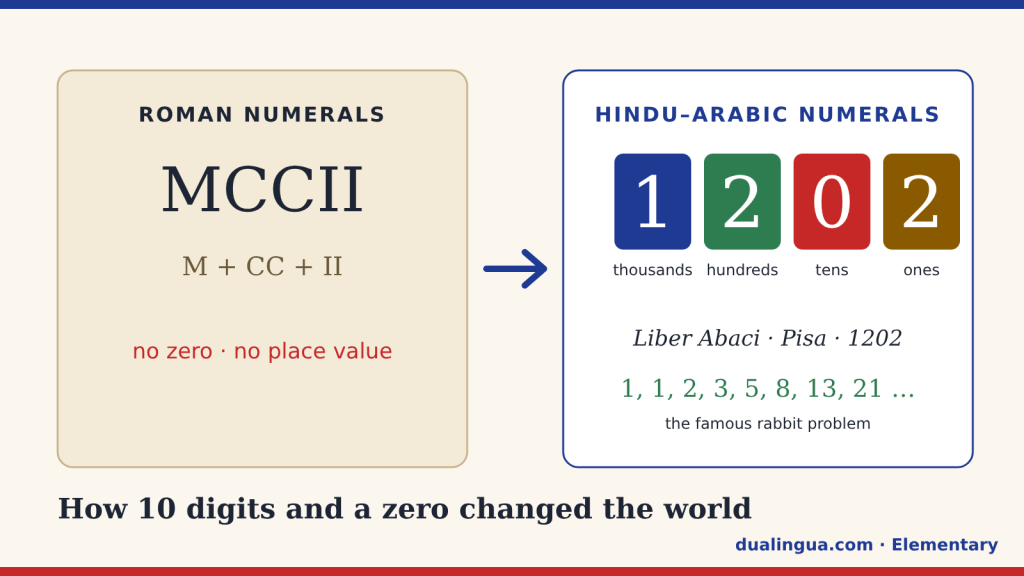
Try writing 1202 in Roman numerals: MCCII. Now try adding MCCII + CDLXXIV in your head. Not easy! Today we use just ten digits, 0 to 9, and a clever idea called place value. Here is the true story of how those digits reached us.
The story
Long ago, mathematicians in India developed a way of writing numbers with only ten symbols. The value of a digit depends on its place: in 1202, the first 2 means two hundred, the last 2 means just two. To make this work, you need a symbol for “nothing here”: zero.
In 628, the Indian mathematician and astronomer Brahmagupta wrote a book called the Brahmasphutasiddhanta. In it, he gave rules for calculating with zero, for example that zero multiplied by any number is zero.
Scholars in the Arab world, such as al-Khwarizmi in Baghdad in the 9th century, wrote books about this Indian way of calculating, and it spread across North Africa. That is why we call our digits Hindu–Arabic numerals.
Then came a boy from Pisa, in Italy: Leonardo, born around 1170. His father worked as a merchant and customs official in Bugia (today Béjaïa, in Algeria), and Leonardo learned the new numbers there. In 1202 he finished a book called Liber Abaci, the “Book of Calculation”, which showed European merchants how useful these digits were.
His book also has a famous puzzle about rabbits. Its answer is the sequence 1, 1, 2, 3, 5, 8, 13… where each number is the sum of the two before it. Fun fact: Leonardo did not call himself “Fibonacci”. The nickname, meaning “son of Bonacci”, became popular centuries later, in the 1800s.
Timeline
| When | What happened |
|---|---|
| 628 | Brahmagupta writes rules for calculating with zero |
| 9th century | Scholars in Baghdad write about the Indian numerals |
| around 1170 | Leonardo of Pisa (Fibonacci) is born |
| 1202 | He completes Liber Abaci |
| 1838 | The nickname “Fibonacci” becomes widely used after a historian’s book |
What this means for your maths
In 1202, the zero in the tens place is not “nothing”: it tells you that there are no tens, and it keeps the 1 in the thousands place. Without it, 1202 would become 122! This is the idea behind our free lesson on place value and rounding.
3 tips
- Draw a place-value chart (thousands, hundreds, tens, ones) and put each digit in its box.
- Zero is a placeholder: 205 and 25 are very different numbers.
- Practise the Fibonacci pattern: start with 1, 1 and always add the last two numbers.
Try it
- What does the 0 in 1202 tell us?
- Write 3,405 in expanded form.
- What comes next: 1, 1, 2, 3, 5, 8, 13, 21, …?
Show the answers
1. There are no tens.
2. 3,000 + 400 + 0 + 5
3. 34 (13 + 21)
Practise for free: Place value and rounding (grades 2–4)
Want a patient teacher? Dualingua offers live online maths lessons from grade 1 to exam preparation, in English or French. Book a free assessment.
More free maths: all free maths lessons · the Dualingua maths blog