
Read in: English · Français · Español · العربية · 中文
Being excellent at maths is not about being born a “maths person”. It is mostly about how you practise. Researchers have tested many study methods, and some popular ones, like rereading and highlighting, turn out to help very little. Here is what works.
The big review: which methods work?
In 2013, a team led by psychologist John Dunlosky reviewed hundreds of studies on ten popular learning techniques. Two came out on top: practice testing (quizzing yourself) and distributed practice (spreading study over time). Highlighting, rereading and summarising were rated low.
Mix your problems: the interleaving surprise
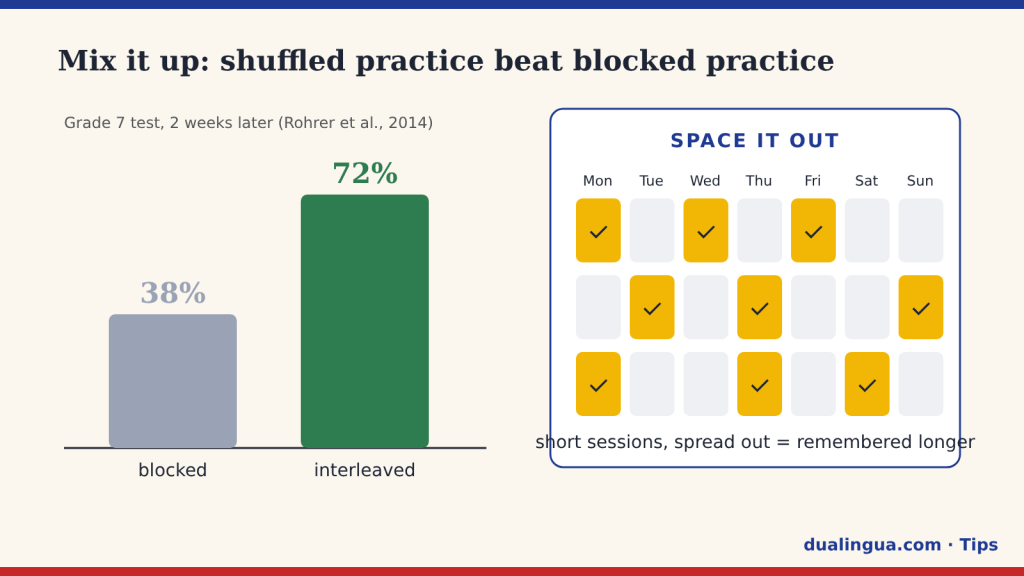
Textbooks often give 20 problems of the same type in a row. That is called blocked practice. Psychologist Doug Rohrer and his colleagues tested another way: interleaved practice, where different types of problems are mixed together.
In a study with 140 grade 7 students, the two groups practised for nine weeks. On a surprise test two weeks later, the interleaved group scored 72%, the blocked group only 38%. Mixing forces your brain to ask “which method do I need here?”, which is exactly what tests ask.
What the research says
| Method | How useful? |
|---|---|
| Quizzing yourself (practice testing) | High |
| Spreading study over days (distributed practice) | High |
| Mixing problem types (interleaving) | Very useful for maths |
| Rereading notes, highlighting | Low |
5 habits of excellent maths students
- Close the book and test yourself. Cover the solution, try the problem, then check.
- Study a little, often. Three short sessions in a week beat one long session the night before.
- Mix it up. After learning a new topic, practise it together with older topics.
- Learn from mistakes. Keep a “mistake notebook”: write the error, the correct method and why.
- Explain it out loud. If you can teach a step to a friend, you really understand it.
Next step: Test yourself with the exercises in our free maths lessons
Want a patient teacher? Dualingua offers live online maths lessons from grade 1 to exam preparation, in English or French. Book a free assessment.
More free maths: all free maths lessons · the Dualingua maths blog
Sources
- Which study strategies make the grade? – Association for Psychological Science (Dunlosky et al., Psychological Science in the Public Interest, 2013)
- Rohrer, Dedrick & Stershic: Interleaved practice improves mathematics learning – Psychonomic Bulletin & Review (Springer), 2014
- Writing about worries eases anxiety and improves test performance – University of Chicago News