
Read in: English · Français · Español · العربية · 中文
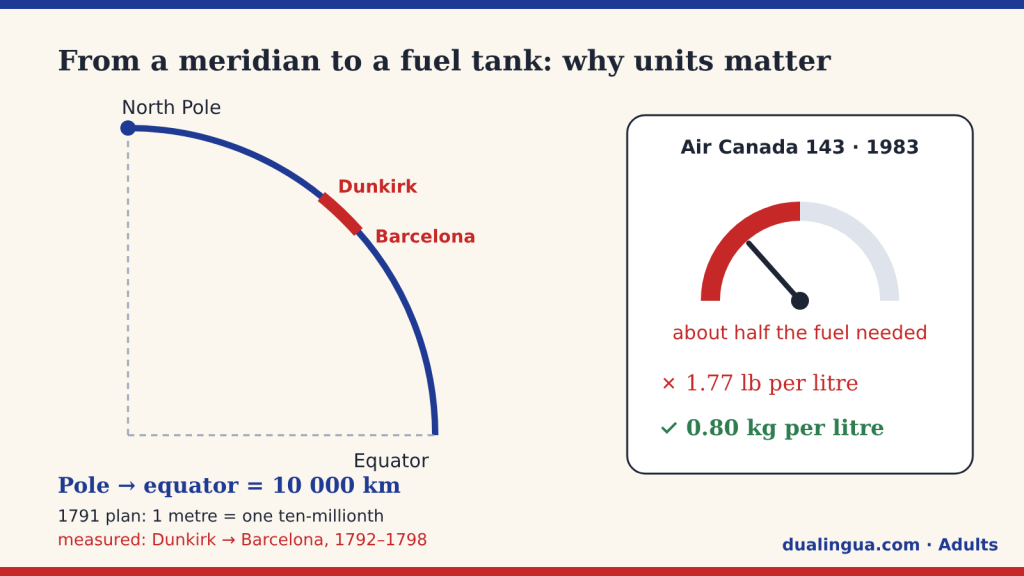
On 23 July 1983, a brand-new Air Canada Boeing 767 flying from Montreal to Edmonton ran out of fuel in the middle of the flight. The reason was not a broken tank. It was a maths mistake with units.
From a meridian to a fuel tank
Our story starts in France. In 1791, scientists defined a new unit, the metre, as one ten-millionth of the distance from the North Pole to the equator. To measure it, the astronomers Delambre and Méchain surveyed the line from Dunkirk to Barcelona between 1792 and 1798. A French law adopted the metric system in 1795, and a platinum metre bar was made in 1799. Since 1983, the metre has been defined using the speed of light.
Canada changed to the metric system in the 1970s. Weather forecasts started giving temperatures in degrees Celsius on 1 April 1975, road signs changed to kilometres in September 1977, and petrol stations began selling fuel by the litre in 1979.
Air Canada Flight 143 was one of the airline’s first planes to measure fuel in metric units. Its fuel computer was not working, so the ground crew in Montreal calculated the fuel by hand. They used 1.77, the number of pounds in a litre of fuel, when the plane needed kilograms: about 0.8 kg per litre. Since 1.77 ÷ 0.8 ≈ 2.2, the plane left with only about half the fuel it needed.
Both engines stopped. Captain Robert Pearson and First Officer Maurice Quintal glided the plane to a former air force base at Gimli, Manitoba, where a go-kart race was taking place on the old runway. All 61 passengers survived; the only injuries happened on the emergency slide. The plane became famous as the “Gimli Glider”.
Timeline
| When | What happened |
|---|---|
| 1791 | The metre is defined from the size of the Earth |
| 1792–1798 | Delambre and Méchain measure from Dunkirk to Barcelona |
| 1 April 1975 | Canadian weather forecasts switch to Celsius |
| September 1977 | Canadian road signs switch to kilometres |
| 23 July 1983 | Air Canada Flight 143 lands at Gimli without fuel |
What this means for your maths
The error was one number with the wrong unit. When you convert, write the units at every step: 1 kg ≈ 2.2 lb, so 1 lb ≈ 0.45 kg. If the units do not cancel correctly, the answer is wrong, however careful your arithmetic is. Our free lesson on metric units practises this.
3 tips
- Always write the unit next to every number, not just in the final answer.
- Multiply by a fraction worth 1, such as (1 kg / 2.2 lb), so that the unit you do not want cancels.
- Estimate first: if your answer is twice or half what you expected, check the units.
Try it
- 2.5 kg = ? g
- Using 1 kg ≈ 2.2 lb, how many pounds is 10 kg?
- Convert 25 °C to °F.
Show the answers
1. 2,500 g
2. About 22 lb
3. 25 × 9/5 + 32 = 77 °F
Practise for free: Metric units and conversions (adults)
Want a patient teacher? Dualingua offers live online maths lessons from grade 1 to exam preparation, in English or French. Book a free assessment.
More free maths: all free maths lessons · the Dualingua maths blog