
Read in: English · Français · Español · العربية · 中文
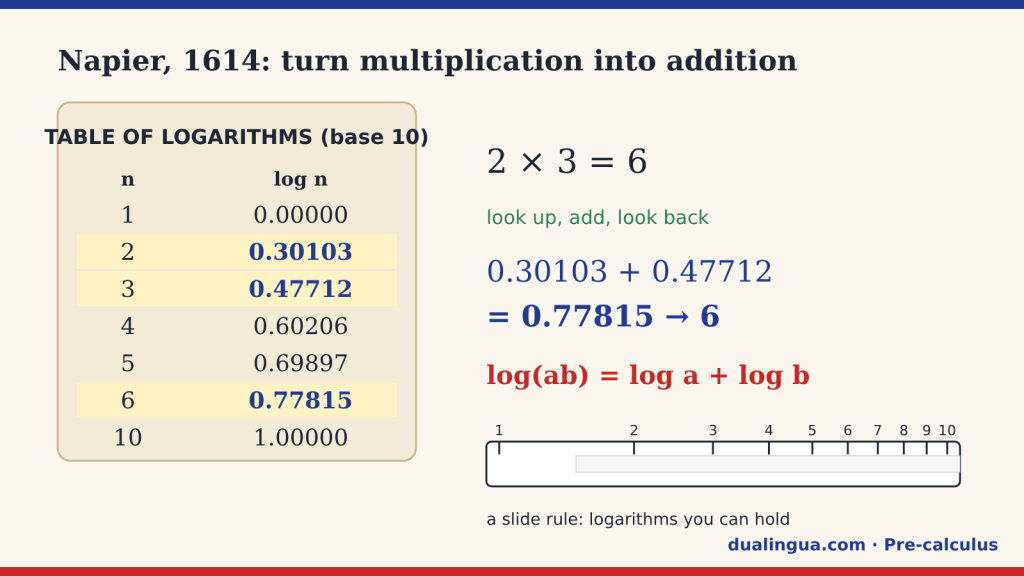
Imagine multiplying 7,842,316 by 5,129,047 by hand, again and again, to work out the position of a planet. For astronomers and navigators 400 years ago, this was daily work. Then a Scottish landowner found a shortcut: logarithms.
The story
John Napier, Laird of Merchiston near Edinburgh, published his discovery in 1614 in a Latin book, Mirifici Logarithmorum Canonis Descriptio, “A Description of the Wonderful Rule of Logarithms”. It explained the idea and gave a table of values.
The big idea: every positive number can be written as a power, and when you multiply powers, you add the exponents. So with a table of logarithms, a hard multiplication becomes a look-up, an easy addition, and a second look-up.
In London, the professor Henry Briggs was so impressed that he travelled to Edinburgh in the summer of 1615 and stayed with Napier for a month. Together they agreed on a better version: the logarithm of 1 would be 0 and the system would be based on powers of 10. Briggs visited again the next summer. Napier died in 1617, and Briggs published his great table, the Arithmetica Logarithmica, in 1624.
Base-10 logarithms, still called common logarithms, were used by scientists and engineers for about 350 years, in printed tables and on slide rules, until pocket calculators arrived in the 1970s.
Timeline
| When | What happened |
|---|---|
| 1614 | Napier publishes the Descriptio |
| summer 1615 | Henry Briggs visits Napier in Edinburgh for a month |
| 1617 | Death of John Napier |
| 1624 | Briggs publishes the Arithmetica Logarithmica |
| 1970s | Pocket calculators replace log tables and slide rules |
What this means for your maths
A logarithm answers one question: “what exponent do I need?” log10(1000) = 3 because 10³ = 1000. The rule that made Napier famous is log(ab) = log a + log b. Look at the picture: log 2 + log 3 = 0.30103 + 0.47712 = 0.77815 = log 6.
3 tips
- Translate every log into a power: logb(x) = y means by = x.
- Learn the three rules: log(ab) = log a + log b, log(a/b) = log a − log b, log(an) = n·log a.
- Watch out: log(a + b) is NOT log a + log b.
Try it
- log10(1000) = ?
- log 2 + log 5 = ?
- log2(8) = ?
Show the answers
1. 3
2. log 10 = 1
3. 3, because 2³ = 8
Practise for free: Exponents and logarithms (pre-calculus)
Want a patient teacher? Dualingua offers live online maths lessons from grade 1 to exam preparation, in English or French. Book a free assessment.
More free maths: all free maths lessons · the Dualingua maths blog