
Read in: English · Français · Español · العربية · 中文
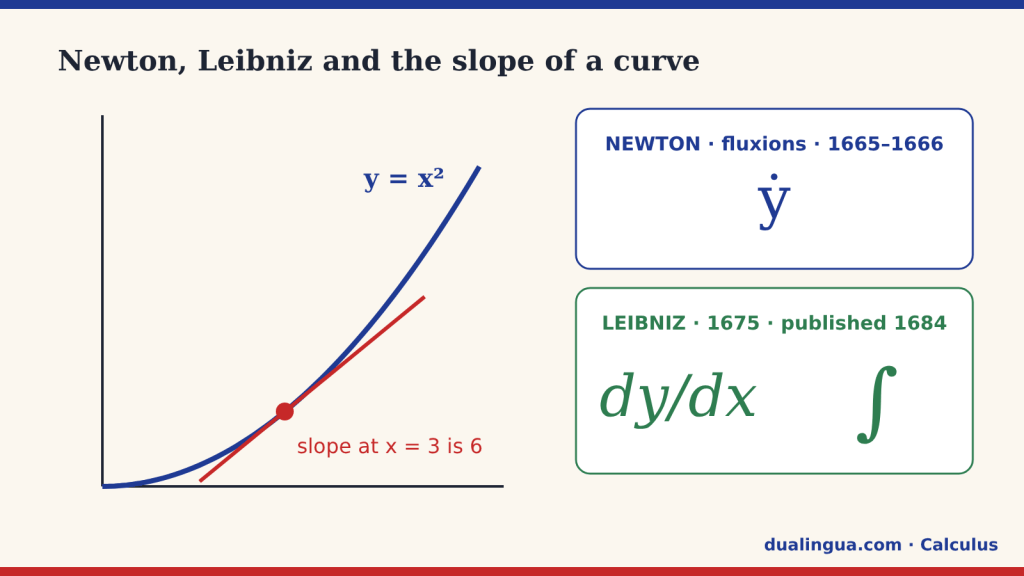
When you write dy/dx in a calculus class, you are using the notation of one man. When you study the motion of planets with calculus, you are following the work of another. For years, these two geniuses, and their supporters, argued about who had invented calculus first.
The story
In England, the young Isaac Newton worked out his “method of fluxions”, his version of calculus, in 1665–1666; a manuscript from October 1666 records it. He used dots over letters, such as ẏ, for rates of change. But he did not publish it for many years: his geometric methods appeared in the Principia in 1687, and his fluxion notation only in 1693 and 1704.
In Paris, the German scholar Gottfried Wilhelm Leibniz developed his own calculus from 1674. By 1675 his notebooks used the notation we still learn today: dx, dy/dx and the long S, ∫, for “sum”. He was the first to publish, in 1684, in a short paper called Nova Methodus pro Maximis et Minimis, “A New Method for Maxima and Minima”.
Years later, supporters of each side accused the other of copying. In 1712, the Royal Society of London, whose president was Newton himself, set up a committee. Its report, published as the Commercium Epistolicum, favoured Newton. It was largely written by Newton, and the committee never asked Leibniz for his side of the story.
Today, historians agree that Newton and Leibniz invented calculus independently. Newton got there first; Leibniz published first, and his notation won: almost every calculus textbook in the world uses it.
Timeline
| When | What happened |
|---|---|
| 1665–1666 | Newton develops his method of fluxions |
| 1675 | Leibniz writes dx and ∫ in his notebooks |
| 1684 | Leibniz publishes Nova Methodus, the first printed calculus |
| 1687 | Newton publishes the Principia |
| 1712–1713 | The Royal Society report favours Newton |
What this means for your maths
Both men were answering the same question: how steep is a curve at one point? That is the derivative. For y = x², the slope of the tangent at x = 3 is 6. With Leibniz’s notation: dy/dx = 2x, so at x = 3, dy/dx = 6.
3 tips
- Read dy/dx as “the rate of change of y with respect to x”: it is a slope.
- Use the power rule first: d/dx [xn] = n·xn−1.
- Check your derivative on a graph: where the curve is flat, the derivative is 0.
Try it
- d/dx [x³] = ?
- What is the slope of y = x² at x = 3?
- d/dx [5x] = ?
Show the answers
1. 3x²
2. 6
3. 5
Practise for free: Derivatives: the basic rules (calculus)
Want a patient teacher? Dualingua offers live online maths lessons from grade 1 to exam preparation, in English or French. Book a free assessment.
More free maths: all free maths lessons · the Dualingua maths blog