
Read in: English · Français · Español · العربية · 中文
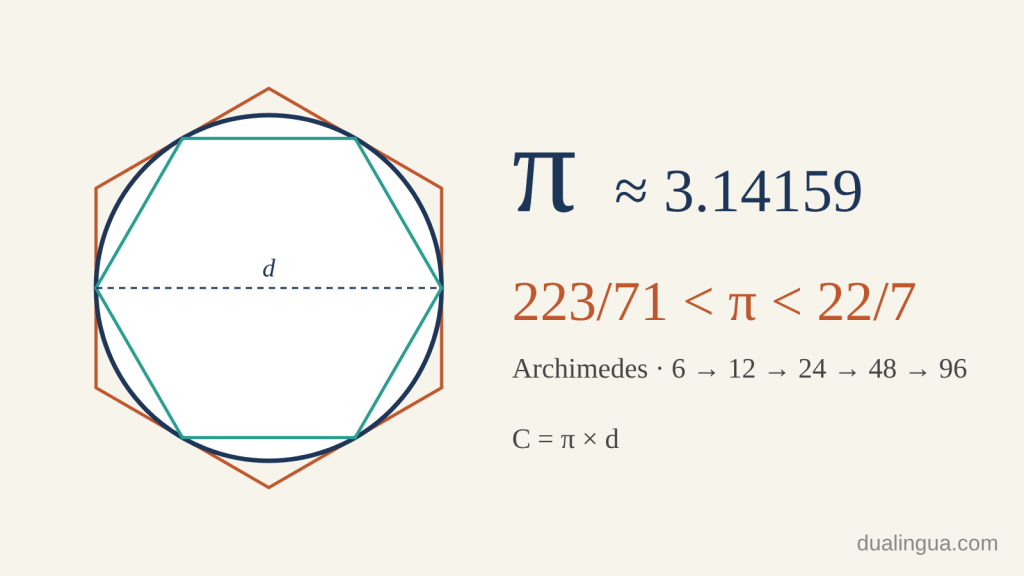
Take any circle: a coin, a bicycle wheel, a pizza. Measure the distance around it and divide by the distance across it. You always get the same number, a little more than 3. We call it pi (π), and people have been chasing its exact value for about 4,000 years.
The story
Early mathematicians already knew that the number was close to 3. Babylonian scribes used 25/8 = 3.125. In Egypt, the Rhind papyrus, written about 1650 BC, uses a rule that gives 4 × (8/9)², about 3.16.
The big step came from Archimedes of Syracuse (287–212 BC). He could not measure a curved line exactly, so he trapped the circle between two shapes with straight sides: one polygon inside the circle and one outside. The circle is longer than the inner polygon and shorter than the outer one. He started with 6 sides and doubled again and again: 12, 24, 48 and finally 96 sides. His result: π is bigger than 223/71 and smaller than 22/7. That is why many students still use 22/7 today.
About 700 years later, the Chinese mathematician Zu Chongzhi (430–501) found the fraction 355/113, which is correct to six decimal places. Around 1600, Ludolph van Ceulen calculated 35 decimal places.
And the symbol? The Welsh mathematician William Jones was the first to use π with its present meaning, in 1706. Leonhard Euler adopted it in 1737, and it soon became the standard. In 1761 Johann Lambert proved that π is irrational: its decimals never end and never repeat in a pattern.
One last lesson in checking your work: in 1873 William Shanks published 707 decimal places of π, calculated by hand. In 1945 a mistake was found, and only the first 527 places were correct.
Timeline
| When | What happened |
|---|---|
| about 1650 BC | The Rhind papyrus uses a value close to 3.16 |
| 287–212 BC | Archimedes shows that 223/71 < π < 22/7 |
| 430–501 | Zu Chongzhi finds 355/113 |
| 1706 | William Jones uses the symbol π |
| 1737 | Euler adopts the symbol |
| 1761 | Lambert proves that π is irrational |
What this means for your maths
π is the circumference of a circle divided by its diameter. So the circumference is C = π × d (or 2 × π × r), and the area is A = π × r². In most school questions you use 3.14, 22/7 or the π key on your calculator.
3 tips
- Check whether the question gives the radius or the diameter. The diameter is twice the radius.
- 3.14 and 22/7 are only approximations. If the question says “leave your answer in terms of π”, write 9π, not 28.27.
- Circumference is a length (cm), area is a surface (cm²). Write the units to catch mistakes.
Try it
- A circle has a diameter of 10 cm. What is its circumference? (Use π ≈ 3.14.)
- Is 22/7 a little bigger or a little smaller than π?
- A circle has a radius of 3 cm. What is its area in terms of π?
Show the answers
1. 3.14 × 10 = 31.4 cm
2. A little bigger: 22/7 = 3.1428…, and π = 3.1415…
3. π × 3² = 9π cm², about 28.3 cm²
Practise for free: free maths practice, grades 1 to 12
Want a patient teacher? Dualingua offers live online maths lessons from grade 1 to exam preparation, in English or French. Book a free assessment.
More free maths: all free maths lessons · the Dualingua maths blog
References
Disclaimer: This article is for general educational purposes only. We checked it against the references above, but it does not replace your teacher, your textbook or your school’s official curriculum. Dualingua Language School is not affiliated with the organisations cited.
Last reviewed: November 21, 2026