
Read in: English · Français · Español · العربية · 中文
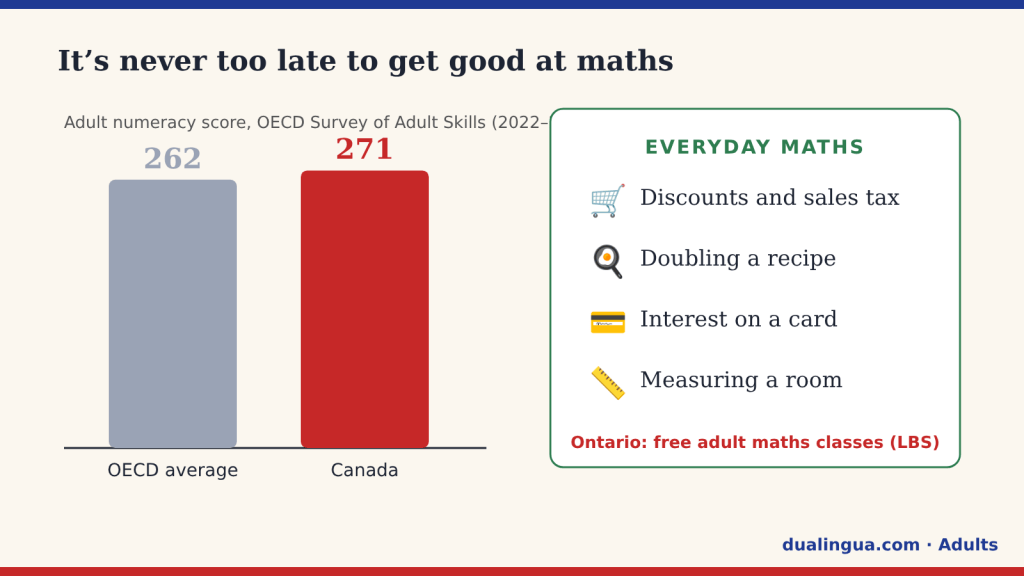
Many adults say “I was never good at maths” and quietly avoid it. But maths in adult life is not about exams. It is about deciding if a sale is a good deal, adjusting a recipe, understanding a loan or helping your child with homework. And these skills can be improved at any age.
What a big international survey says
The OECD Survey of Adult Skills tests adults aged 16 to 65 in many countries on literacy, numeracy and problem solving. In the latest round, collected in 2022 and 2023, adults in Canada scored 271 in numeracy, above the OECD average of 262, according to Statistics Canada.
The same results show big differences between people: adults aged 25 to 34 had the highest scores and adults aged 55 to 65 the lowest. In other words, many adults have not used their maths for years, and skills fade when they are not practised.
Start again, gently
You do not need to restart from grade 1. Start with the maths you need this week. For example, which is cheaper: 750 g of coffee for $4.50, or 1 kg for $5.40? Find the price per 100 g: $0.60 and $0.54. The bigger bag is the better deal.
In Ontario, adults aged 18 and over whose skills are below grade 12 level can join the Literacy and Basic Skills program, which is free and includes maths. Other provinces have similar adult learning programs. You can also read our true story of the Gimli Glider, an Air Canada flight that ran out of fuel because of a units mistake.
Maths you already use
| Everyday situation | The maths behind it |
|---|---|
| Comparing prices | Unit price: price ÷ quantity |
| Sales and taxes | Percentages |
| Doubling a recipe | Multiplying fractions |
| Credit cards and loans | Interest rates |
| Painting a room | Area: length × width |
5 ways to rebuild your maths confidence
- Use real life: calculate the tip, the discount or the unit price before the cashier does.
- Estimate first: “about $50” is a great start before the exact answer.
- Practise little and often: 10 minutes a day works better than a long weekend session.
- Forgive old memories: school was one experience, not a verdict on your brain.
- Join a free class or ask a patient teacher: learning with others makes it easier.
Next step: Try our free lesson on discounts, sales tax and tips
Want a patient teacher? Dualingua offers live online maths lessons from grade 1 to exam preparation, in English or French. Book a free assessment.
More free maths: all free maths lessons · the Dualingua maths blog