
Read in: English · Français · Español · العربية · 中文
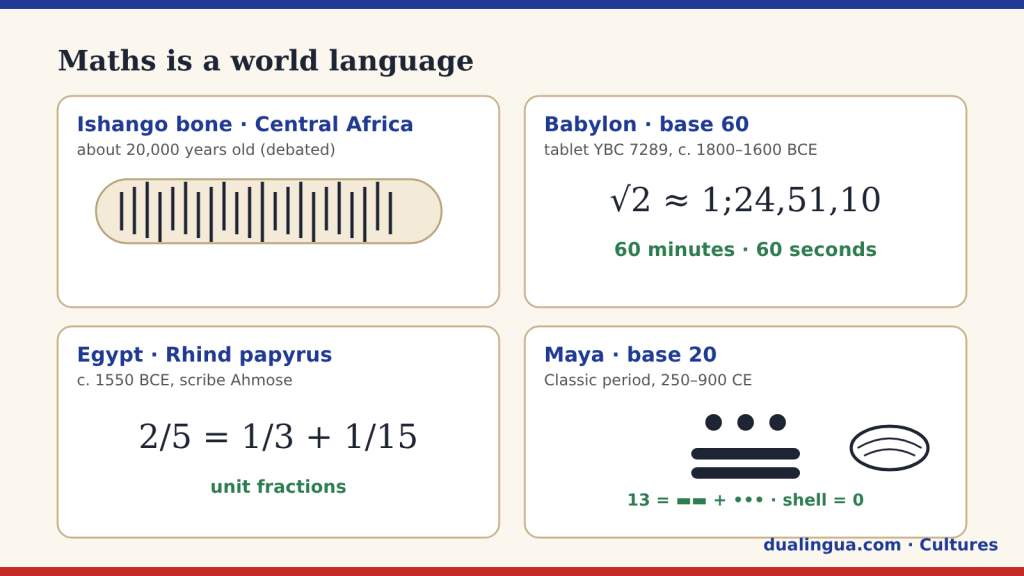
Maths was not invented by one person or one country. People all over the world needed to count animals, share bread, measure fields and follow the stars, and they found clever ways to do it. Let’s travel through time and see four of them.
Africa: the Ishango bone
In 1950, the Belgian geologist Jean de Heinzelin found a small bone near the Semliki River, in today’s Democratic Republic of the Congo. It has 168 notches in three columns. It is thought to be about 20,000 years old, although the date is debated. Some researchers think the marks show counting; others think they are a calendar. Nobody knows for sure, but it is one of the oldest objects that may record numbers. It is kept in Brussels at the Royal Belgian Institute of Natural Sciences.
Babylon: counting in 60s
In ancient Mesopotamia (today’s Iraq), people counted in base 60. A small clay tablet called YBC 7289, from around 1800–1600 BCE, shows a square with its diagonals and a value for √2 written as 1;24,51,10 in base 60. That is about 1.414213, correct to about six digits! We still use their base 60 every day: 60 seconds in a minute and 60 minutes in an hour.
Egypt: fractions made of pieces
The Rhind Mathematical Papyrus was copied around 1550 BCE by a scribe called Ahmose, from an older text. It contains about 90 problems. Egyptians wrote most fractions as sums of different unit fractions (with 1 on top): for example, 2/5 = 1/3 + 1/15. The papyrus also uses 256/81 ≈ 3.16 for the number we now call π.
The Maya: a shell for zero
The Maya of Mexico and Central America, whose Classic period lasted from about 250 to 900 CE, counted in base 20. They needed only three symbols: a dot for 1, a bar for 5, and a shell for zero. So 13 is two bars and three dots.
Read also our stories about other cultures: Where Do Our Numbers Come From? The Story of Zero and Fibonacci · Fortunes and Debts: The Surprising History of Negative Numbers · Al-Khwarizmi: The Baghdad Scholar Who Gave Us the Word “Algebra”.
Maths around the world at a glance
| Culture | Invention | Still used today? |
|---|---|---|
| Central Africa (Ishango) | Marks that may record numbers | Tally marks |
| Babylon | Base 60 | 60 minutes, 60 seconds |
| Egypt | Unit fractions | Fractions in recipes and measures |
| Maya | Base 20 with a zero | The idea of zero as a placeholder |
5 challenges to try (answers in brackets)
- Write 7 in Maya numbers. (one bar and two dots)
- Write 19 in Maya numbers. (three bars and four dots)
- Check the Egyptians: is 1/2 + 1/4 + 1/4 a correct Egyptian fraction? (No: Egyptian fractions use different unit fractions, so 1/2 + 1/4 + 1/4 would be written as 1 itself.)
- How many seconds are in 2 hours, thanks to base 60? (2 × 60 × 60 = 7,200)
- Make your own Ishango stick: draw notches for the days until your birthday.
Next step: Practise fractions with our free lesson
Want a patient teacher? Dualingua offers live online maths lessons from grade 1 to exam preparation, in English or French. Book a free assessment.
More free maths: all free maths lessons · the Dualingua maths blog
Sources
- Ishango bone – Wikipedia (Royal Belgian Institute of Natural Sciences collection)
- YBC 7289 – Before Pythagoras exhibition, Institute for the Study of the Ancient World, New York University
- Rhind Mathematical Papyrus – Wikipedia (British Museum, EA 10057)
- Mayan mathematics – MacTutor History of Mathematics, University of St Andrews